There are around 6,000 known mineral species, but the good news for beginners is that a few dozen make up nearly everything you'll find. Mineral identification is the skill of narrowing those candidates using observable properties — and it's never been easier to learn, because you now have an expert-level second opinion in your pocket.
The classic identification tests
Hardness (Mohs scale)
The single most useful test. Fingernail ≈ 2.5, copper coin ≈ 3.5, steel knife ≈ 5.5, glass ≈ 5.5, quartz = 7. What scratches your mineral — and what it scratches — brackets its hardness. Talc (1) to diamond (10).
Streak
Rub the mineral on unglazed porcelain: the powder color is more diagnostic than the body color. Pyrite looks gold but streaks greenish-black; real gold streaks gold.
Luster
Metallic, glassy (vitreous), pearly, silky, greasy, dull. Luster is judged on a fresh surface and instantly separates whole mineral families.
Cleavage & fracture
Minerals break along planes of weakness. Mica peels into sheets; calcite breaks into perfect rhombs; quartz has no cleavage and fractures like glass (conchoidal).
Crystal habit
The shape a mineral naturally grows in — cubes (pyrite, fluorite, halite), hexagonal prisms (quartz, beryl), needles (natrolite), bands (agate, malachite).
The modern method: all five tests, one photo
These observations are exactly the visual features an AI model reads from a good photograph — plus color, transparency and surface texture, cross-referenced in seconds against thousands of species. It's like having the checklist run automatically, with the reference book built in.
Identify a mineral with Mineral Identifier AI
- Download Mineral Identifier AI free on iPhone or iPad.
- Photograph the mineral in good light; zoom in on crystal faces, cleavage surfaces or fresh breaks.
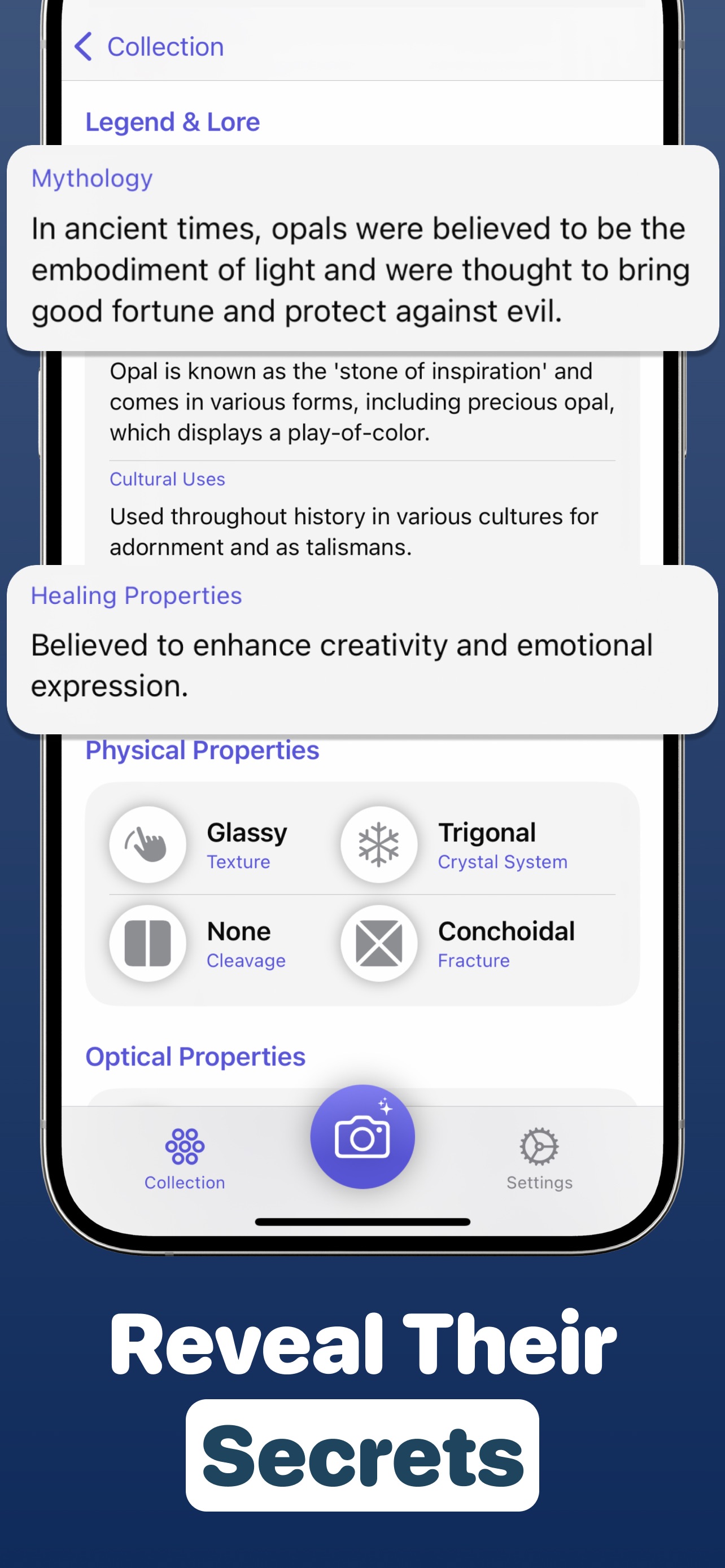
- Review the full profile: name, chemical formula, classification, Mohs hardness, crystal system, cleavage, fracture and optical properties.
- Cross-check: the listed hardness gives you a one-scratch confirmation test if you want physical proof.
- Save and learn: add it to your collection and ask Rocksy how the mineral forms, where it's found and what it's used for.
Accuracy: what to expect
For common minerals photographed sharply in daylight, AI identification is remarkably dependable — and unlike a beginner, it never forgets a rare species that happens to match. Visual twins (gold vs. pyrite, halite vs. calcite) may need one physical follow-up test, which is why every result includes the diagnostic properties to check. Think of it as: the app narrows 6,000 species to one or two; a scratch or streak settles any tie.