Crystal identification trips up beginners for one simple reason: color alone is not enough. Quartz can be purple, pink, smoky or clear. Fluorite comes in green, purple and blue — sometimes in the same specimen. To identify a crystal with confidence you need to read several traits together, or let AI read them for you.
The 5 traits that identify a crystal
- Color & transparency. A starting clue, never the whole answer. Note whether the crystal is transparent, translucent or opaque.
- Crystal shape (habit). Quartz grows six-sided points; pyrite forms cubes; calcite forms rhombohedra. Shape is one of the most reliable tells.
- Luster. Glassy (quartz), pearly (moonstone), metallic (pyrite), waxy (jade) — how a surface reflects light narrows the field fast.
- Hardness. Quartz (Mohs 7) scratches glass; calcite (Mohs 3) doesn't. A fingernail, a coin and a steel key give you a rough hardness ladder.
- Fracture & cleavage. How a crystal breaks — clean flat planes vs. shell-like (conchoidal) surfaces — is a fingerprint geologists rely on.
The instant method: identify crystals by photo
Reading all five traits takes practice — and some tests risk damaging a nice specimen. A crystal identifier app reads color, luster, habit and surface texture from a photo simultaneously and matches them against thousands of reference minerals, with no scratching required.
Identify any crystal with Mineral Identifier AI
- Open Mineral Identifier AI (free on iPhone and iPad) and tap the scan button.
- Photograph your crystal in natural light — zoom in so its faces and terminations fill the frame.
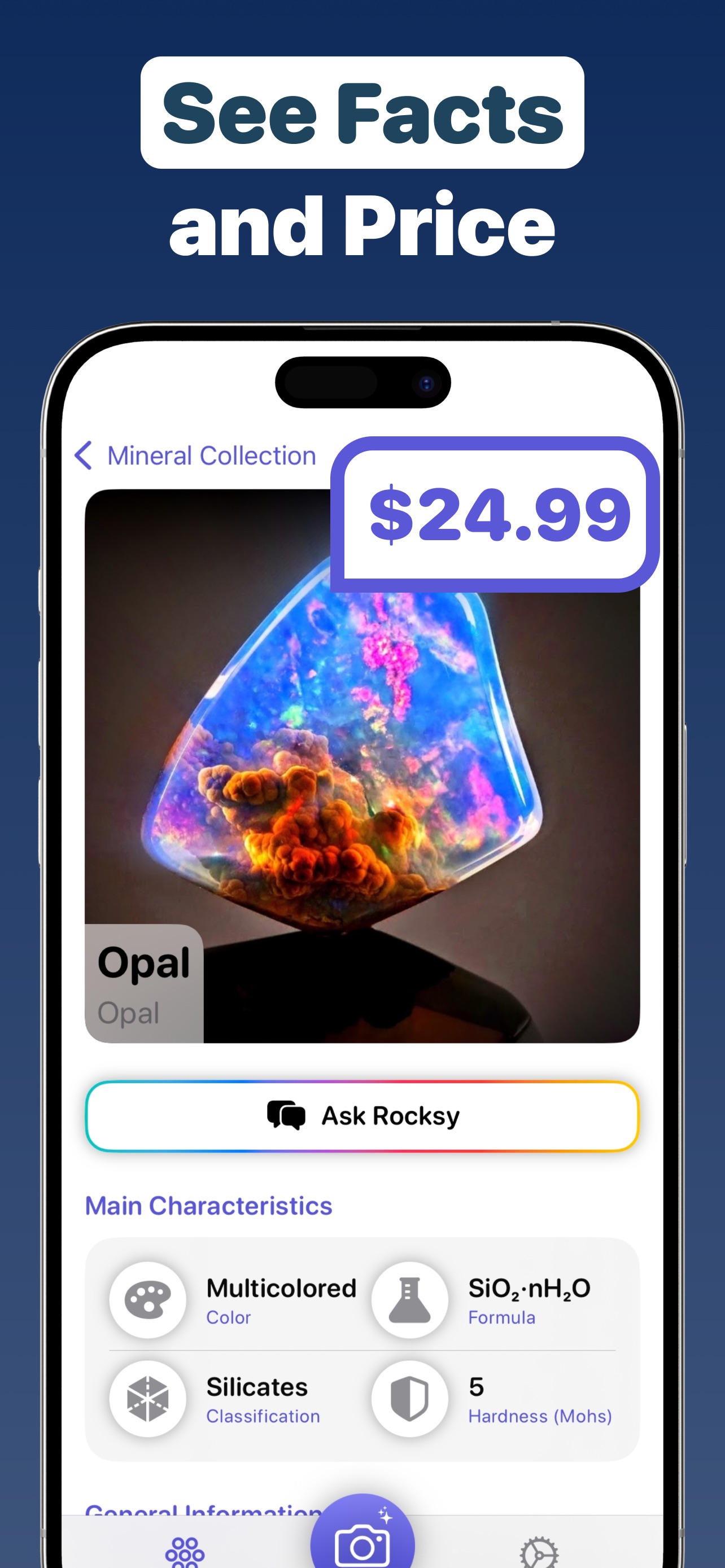
- Read the full profile: name, chemical formula, crystal system, hardness, cleavage and fracture.
- Explore the meaning: every ID includes healing properties, mythology and cultural history in the Legend & Lore section.
- Check its value and save it to your collection — or ask Rocksy, the in-app AI assistant, anything else about your stone.
Common crystals and how to spot them
Clear quartz — glassy, six-sided columns with pointed tips; scratches glass. Amethyst — the purple variety of quartz, often in geode clusters. Rose quartz — translucent pink, usually in solid chunks without visible faces. Calcite — softer, often honey or white, splits into perfect rhombs. Fluorite — vivid greens and purples, forms cubes and octahedra, softer than quartz. Selenite — silky white blades you can scratch with a fingernail. A photo scan distinguishes all of these in seconds — including the tricky dyed or heat-treated stones sold in tourist shops.